GearDüsseldorf
What a stand package includes, and what is billed separately
Jan–Nov
A package stand is quoted by the square metre and settled by the line item. What the headline rate at a Düsseldorf hall genuinely covers, which services are ordered from the hall rather than the builder, and the four invoices that turn up after the fair and surprise people every single time.
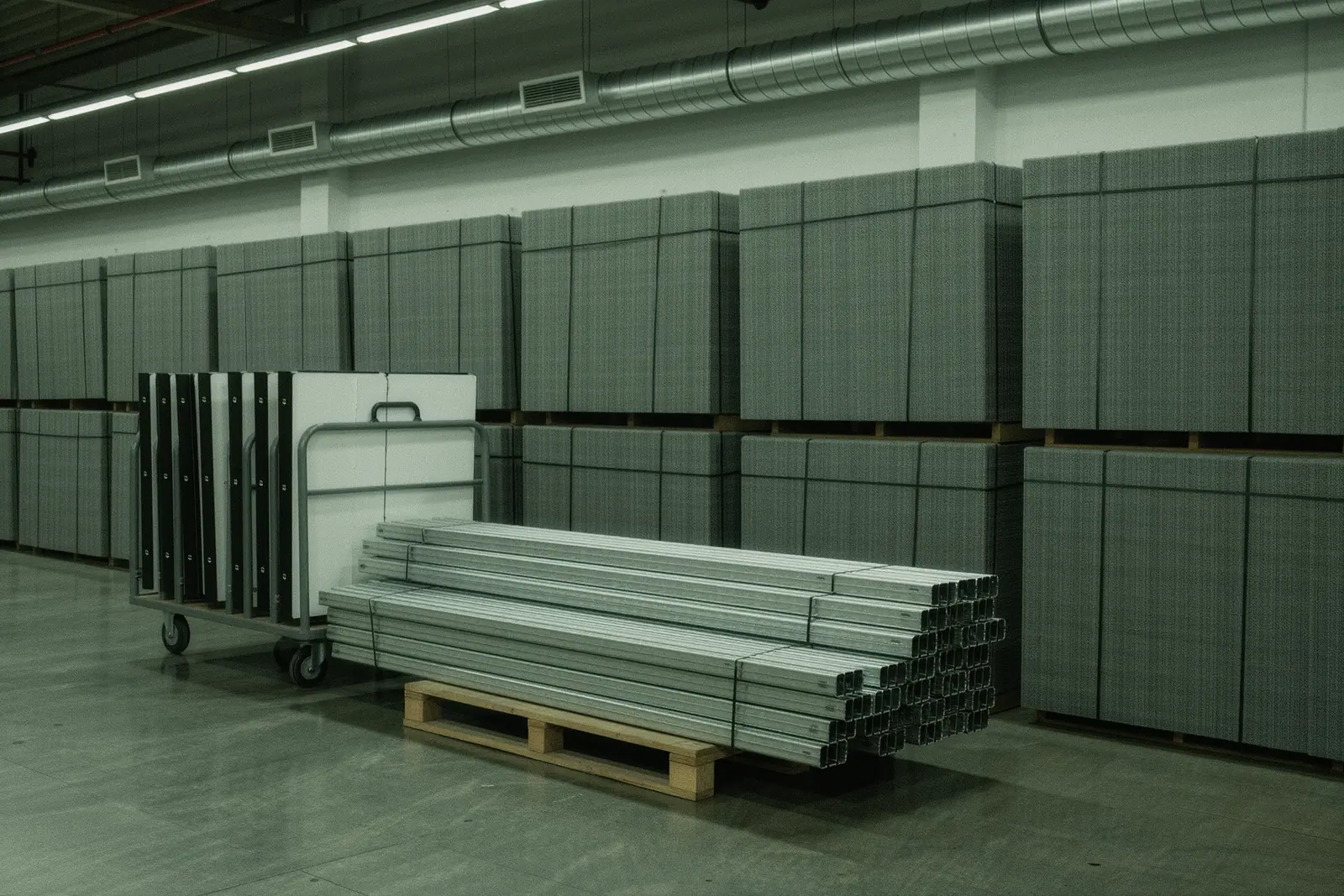
The quote arrives with a number per square metre and a rendering with soft lighting and a plant. Everything in the rendering looks included. Almost nothing in the rendering is included, and at the exhibition grounds here the gap between those two facts gets settled in about eleven separate invoices.
This is not sharp practice. A hall stand is assembled from three supply chains that have never met: the builder, the exhibition grounds themselves, and whatever you hire directly. Understanding which of the three owns each item is most of the skill.
Three parties, one stand
| Item | Usually the builder | Usually the hall | Usually you |
|---|---|---|---|
| Wall system and fascia | Yes | — | — |
| Company name on the fascia | Yes | — | — |
| Overhead spotlights | Yes, a basic number | — | — |
| Floor covering | Often, basic grade | — | Upgrades |
| Electrical connection to the stand | — | Yes | — |
| Sockets and distribution inside | Yes | — | — |
| Standing power overnight | — | Yes, as an order | — |
| Rigging points in the roof | — | Yes | — |
| Water and waste | — | Yes | — |
| Furniture beyond the token pieces | Sometimes | — | Usually |
| Screens, audio, laptops | — | — | Yes |
| Cleaning during the fair | — | Yes | — |
| Waste and packaging removal | — | Yes | — |
| Internet, wired or wireless | — | Yes | — |
Read that table as a checklist rather than a description. The pattern that matters: anything crossing the boundary of your stand belongs to the grounds, anything inside it belongs to the builder or to you.
The four invoices people do not expect
Standing power. Stand lighting runs on the exhibition supply, which is switched off outside opening hours. If you have a fridge, a charging cabinet or a screen that needs to boot before the doors open, you need a separate round-the-clock supply, and it is ordered in advance. The detail of what the halls charge for this is worth reading properly before you sign anything.
Rigging. A banner hung above the stand is not a stand item. It is a roof item, it needs a structural sign-off, and it is ordered from the grounds with its own drawing and its own deadline.
Waste. Packaging, offcuts, pallet wrap and the carpet at the end all have to leave the hall. There is a charge for that, and it is one of the few costs that goes up if you do nothing about it.
Cleaning. Daily stand cleaning is not automatic and it is not free. On a five-day fair with a light-coloured floor, skipping it is visible by Wednesday.

Deadlines are the real currency
The hall service manual for any given fair carries a list of order deadlines, and past each one the price steps. Not by a token amount — by a proportion that is designed to stop late ordering.
A workable sequence for a Düsseldorf fair:
- Five months out. Book the space and the package. Get the inventory list.
- Three months out. Fix the stand drawing. Anything hanging from the roof needs sign-off from here.
- Six to eight weeks out. Place the hall service orders: power, water, internet, cleaning, waste. This is where the surcharge dates usually fall.
- Four to six weeks out. Order the furniture and the technology.
- Two weeks out. Confirm the delivery slot and the vehicle passes.
- Build-up. Anything ordered here costs what it costs.
Setting a personal deadline a week ahead of each of those is not caution. Build weeks in this city cluster, and the same small pool of contractors is working every hall.
Why the number moves between one March and the next
The hall calendar, not the season. Düsseldorf runs a rotation in which some of its largest fairs happen every second year and one or two only every few years. A March in a year when the wine trade fills the halls does not price like a March when it does not, and the same package quote can differ noticeably between two consecutive editions of the same event for no reason other than what else is in town that week.
That is also why quotes taken from a colleague’s file from two years ago are misleading. Use the previous edition of the same fair as your reference, never last quarter.
The question that settles it
Ask the builder for a single sheet listing every item that will be physically on the stand, with a column marked “included” or “extra”, and a second column naming who supplies it. A builder who can produce that in a day is a builder who has done this hall before. One who sends another render instead has told you something useful.
The stand that goes badly is rarely the one with the small budget. It is the one where three people each assumed someone else had ordered the electricity, and the first anyone noticed was on the Monday of build-up, past every deadline in the manual. Getting the delivery slot right will not save you from that; only the inventory sheet will.
What to check before you book
- Ask for the package inventory as a list of parts, not a render. A picture of a stand is not a specification.
- Establish which items come from the builder and which are ordered through the hall. They are separate contracts with separate deadlines.
- Find the late-order surcharge date in the hall service manual and put it in your calendar as a hard stop.
- Confirm whether the price is for the run of the fair or per day, and what happens if you extend by one day.
- Check whether graphics production, fitting and removal are all included. Removal of prints is a real line and it is often missed.
- Ask what the stand looks like with the lights off and the power down, because that is what your evening visitors will see if you skip the standing power order.
- Get the waste and packaging terms in writing before build-up rather than at the end of the last day.
Questions people actually ask
- What is normally inside a Düsseldorf stand package price?
Usually the wall system, a fascia with your company name, basic overhead lighting, a floor covering, and one or two furniture pieces. That is the common core. Anything that draws power beyond the lights, anything that hangs from the hall roof, anything connected to water, and anything that has to be built rather than clipped together will almost always sit outside it.
- Who do I order electricity from, the builder or the hall?
The supply itself comes through the exhibition grounds, and the distribution inside your stand comes from the builder. That split is the single most common misunderstanding on a first stand. The hall brings a connection to the stand boundary and meters it; your builder or electrician takes it from there to the sockets, and both parties invoice you.
- Are the deadlines real or is there always a way round them?
The late-order surcharge dates are real and they are applied. Ordering a socket four weeks out and ordering it on the Tuesday of build-up are the same socket at very different money. Halls run these deadlines because their own contractors need the lead time, and there is no goodwill discount for an exhibitor who missed one.
- Is a package stand cheaper than a custom build?
For anything under about forty square metres, generally yes, and the gap narrows fast above that. The honest comparison is not package against custom but package plus every separate order against custom all-in, because a custom builder tends to absorb items that a package quotes separately. Price both as a total delivered cost.