GearDüsseldorf
The delivery and collection slot problem at the halls
Jan–Nov
Every crate, counter and screen on a Düsseldorf stand arrives through the same doors in the same forty-eight hours. How the slot system works, what a vehicle pass actually buys you, why the marshalling yard is where the day is lost, and why getting out is harder than getting in.

A stand at Stockum is assembled from six or seven deliveries that have never been in the same place before: the build system on a lorry, the furniture on a box van, the graphics in a car, the screens in a hired transporter, the product from a warehouse in the Ruhr, the catering crates on the morning of day one. All of them need the same set of roller doors within the same forty-eight hours, and so does every other exhibitor in the hall.
The slot system is what stops that becoming a permanent traffic jam on the approach roads. It works. It also means that logistics, not design, is the thing most likely to ruin your build.
How the day is structured
| Stage | What happens | Where time is lost |
|---|---|---|
| Approach | Vehicle arrives on the site road network | Wrong gate for the hall |
| Marshalling | Vehicle waits for its window | Turning up early does not help |
| Call-forward | Vehicle is released to the hall | Driver not reachable by phone |
| Dock | Unload, typically a fixed maximum | No one on the stand to receive |
| Clear | Vehicle must leave the apron | Nowhere agreed to park afterwards |
| Empties | Cases go into storage | Not labelled, so they come back wrong |
The two rows worth staring at are call-forward and dock. A vehicle called forward with nobody answering the phone loses its turn, and a vehicle at the dock with nobody on the stand to receive the goods is unloading onto the apron, where the goods are then in everybody’s way and technically nobody’s responsibility.
One person, physically in the hall, with the slot references and the driver numbers on their phone. That is the whole job and it should not be the person also building the stand.
Getting the sequence right
Unload order is reverse build order. It sounds obvious and it is routinely got wrong because the vehicles are loaded in the order things were collected.
- Structure and truss first. Nothing else can happen around it.
- Rigging, while the floor is still clear.
- Electrical first fix.
- Flooring, which is the point of no return for wheeled traffic.
- Furniture and heavy display items.
- Technology, cabled and tested.
- Product, graphics and everything small.
- Catering, on the morning of day one.
Anything that arrives out of order either waits in the aisle, which the hall will object to, or goes onto the stand and gets moved twice.
Empties, which is a Düsseldorf-specific headache
Once your crates are unpacked they cannot stay on the stand and they cannot stay in the aisle. They go into empties storage, and they come back at a time determined by the hall rather than by you.
Three practical points. Label every case with your hall, stand number and company on at least two faces, because a stencilled logo on the lid is invisible when the case is stacked. Photograph the stack before it leaves. And accept that on the final evening the cases will not be back the moment the doors close — they come back in waves, hall by hall, and until yours arrive there is nothing to pack into.
That single fact is why the breakdown routinely runs past midnight and why crews booked to finish at ten cost you an overtime call.
The city outside the gate
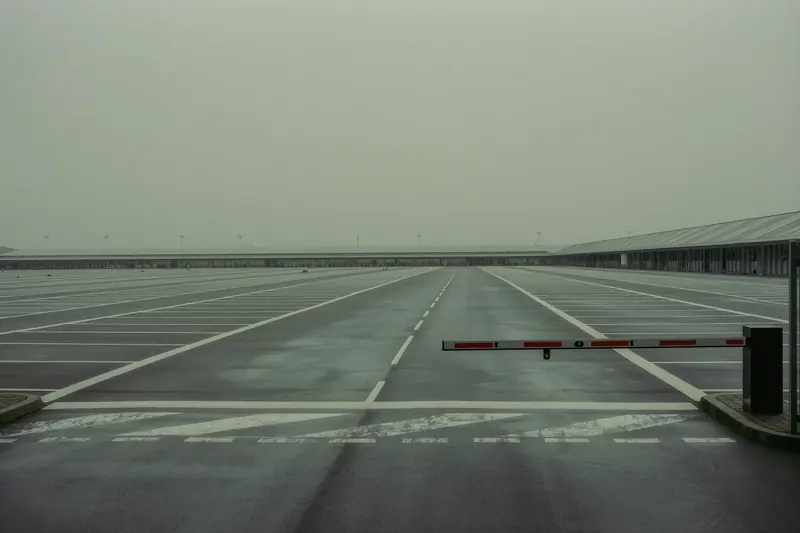
The exhibition grounds sit north of the centre, between the airport and the Rhine, and the approach is off the A44 and A52 with the arena and the car parks between the roads and the halls. In a big week, the roads around the site carry build traffic, visitor coaches and ordinary commuter flow at the same time.
Two consequences worth planning for. Suppliers driving in from the Ruhr or the Rhine-Main area should leave far earlier than the distance suggests, because the motorway ring here is congested in a way that has nothing to do with the fair. And your own team should not be driving to the site at all — the tram from the main station runs to the grounds directly, and in build week that beats hunting for a space in the visitor car parks twice a day. It is also an argument for putting the crew in an apartment on a tram line rather than somewhere that looks closer on a map.
Book the way out first
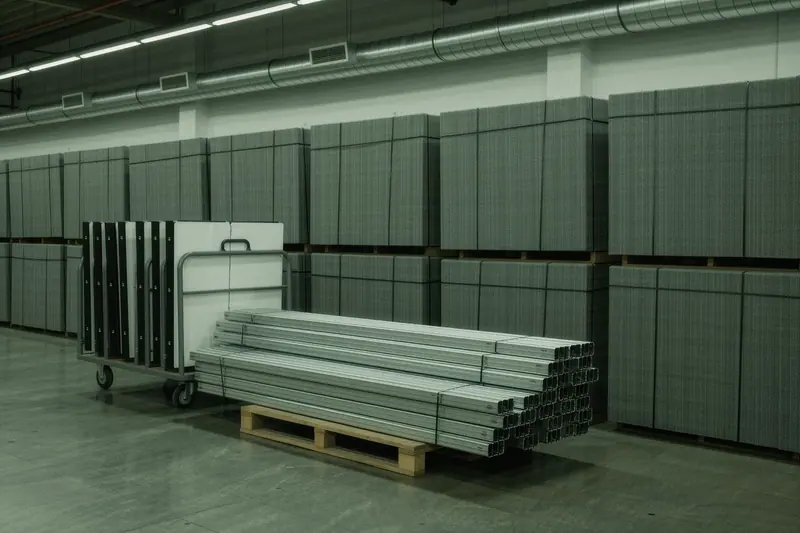
The single change that improves a build most is treating the collection slot as the primary booking. Delivery slots are plentiful across a two or three day build-up; collection slots are compressed into one evening and the following morning, when every exhibitor on the site is trying to leave.
Book it early, book it later in the window rather than immediately at close, and tell your crew the realistic finish. A stand that is packed at two in the morning by people who expected to be finished at ten is where the breakages happen, and hire companies charge for those at replacement value.
What to check before you book
- Book the delivery slot as soon as the system opens, not when the stand is designed. Early slots on the first build day go first.
- Order a vehicle pass for every vehicle, including the small van bringing the screens, and check whether the pass is time-limited.
- Confirm the hall number and the gate, not just the stand number. Adjacent halls are served by different entrances.
- Give every supplier the same slot reference and the same on-site mobile number, and make one person responsible for the door.
- Plan the unload order backwards: what goes in last comes off the vehicle first.
- Book the collection slot at the same time as the delivery slot. It is the one people forget and the one that is scarce.
- Check the rules on forklifts and pallet trucks in your hall. Bringing your own is often not permitted.
Questions people actually ask
- How do delivery slots work at the Düsseldorf exhibition grounds?
Vehicles are given a timed window and a gate, and they queue in a marshalling area until the window opens. The system exists because several hundred vehicles want the same doors on the same morning. You book through the event's logistics arrangements, receive a pass, and the pass is checked at the gate. Details vary by fair, so read the service manual for your specific event.
- What happens if I miss my slot?
You wait. Depending on how busy the build is, that can be an hour or most of a day, and the vehicle sits in the holding area burning driver hours. There is no penalty as such and no priority for having had a slot earlier; you simply rejoin the queue. This is why the first build day matters more than the second — a missed slot on day one still leaves you a day.
- Can I hand-carry small items in without a slot?
Usually yes, on foot or with a hand trolley through a personnel entrance, subject to the rules for that hall and that fair. It is the practical route for laptops, samples and the box of things that were forgotten. It is not a route for a counter or a screen, and attempting it with a pallet truck will be stopped at the door.
- Why is collection harder than delivery?
Because everyone leaves at once. Build-up runs over two or three days with a phased schedule; the breakdown after the final afternoon is a single compressed window in which every exhibitor on the site wants a vehicle at a dock. Empties have to come back out of storage first, and until they do nothing can be packed. Expect the out to take longer than the in.