On the waterDüsseldorf
The Rhine current, and what it means for small craft
Mar–Oct
The Rhine at Düsseldorf moves at roughly walking pace and considerably faster when it is high, and everything difficult about small craft here follows from that. What the groyne fields do to the water near the bank, why a freighter is the hazard you notice last, how to read the gauge before you commit, and the drift you cannot paddle out of.

Stand on the promenade and the Rhine looks placid. Wide, brown, quiet, with the occasional freighter sliding past. It is the calmest looking dangerous thing in the city, and almost everything that goes wrong on this water starts with that impression.
The river here is a single-direction flow of enormous volume, squeezed between engineered banks. Everything that matters for a small hired boat, a club kayak or a rowing shell comes out of that one fact.
The flow, and what it does to your planning
The current runs at roughly walking pace in ordinary conditions and faster after rain in the catchment far upstream — which is why the river can rise on a bright day here. It runs faster in the middle than at the edges, faster at the surface than near the bed, and it does not turn.
| River state | What you notice | What it means for small craft |
|---|---|---|
| Low, late summer and autumn | Gravel and stone showing at the edges | Narrow fairway, traffic concentrated, less room |
| Normal | Steady flow, jetty gangways at a comfortable angle | The usable condition |
| Rising | Debris in the water, gangways steepening | Recovery gets harder before it looks dangerous |
| High | Path by the water closed, fast brown flow | Navigation restricted for everyone |
| Very high | Promenade under water in places | Navigation suspended, nothing goes out |
The gauge for this stretch is published and it is the number to look at, together with the trend over the previous two days. A falling river after a high week is still carrying whole trees.
Groyne fields: the calm-looking part
Along both banks, stone spurs run out into the river at regular intervals. Their job is to push the flow into the middle so the fairway scours itself deep enough for freight. The side effect is a series of bays between them where the water does something entirely different to the main stream.
Inside those bays the flow turns back on itself. There is often a distinct line where the eddy meets the main current, and crossing it in a small craft produces an abrupt shove that has capsized better paddlers than the ones who try it. There is also a pull along the length of the stones themselves.
From the embankment this is the part of the river that looks like the safe part. It is not. It is the reason swimming on this stretch is discouraged, and the reason club paddlers here keep a specific distance off the bank rather than hugging it.
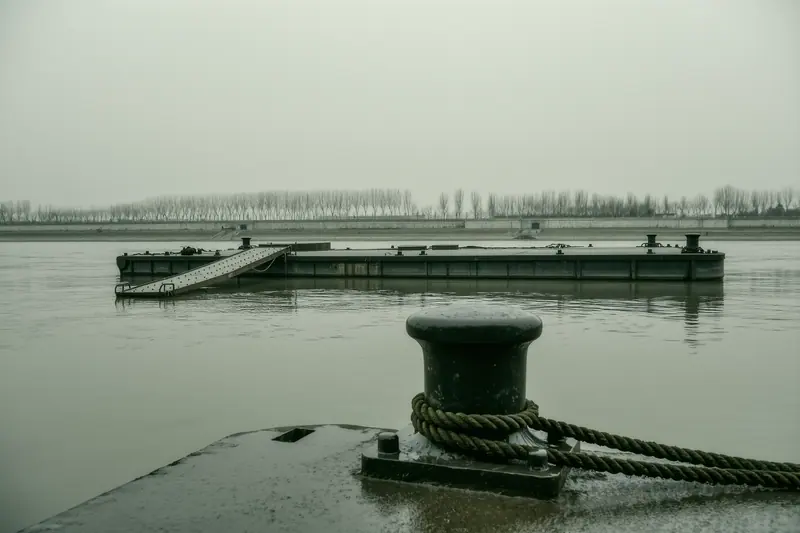
Commercial traffic is the other half of the problem
A loaded freighter or a push-tow on this stretch is long, heavy and constrained to the fairway. It cannot stop in any distance that helps you, it cannot leave the channel, and from the wheelhouse a small boat close under the bow is invisible.
Three habits, none of them optional:
- Cross behind, never ahead. The gap you judge from a hundred metres is gone by the time you are halfway across.
- Meet the wash bow-on. The bow wave and the following wash arrive separately, and the second one is usually the bigger.
- Do not be between a moving vessel and a groyne field. The water there gets confused, and it does so where you have least room.
The drift you cannot paddle out of
Here is the arithmetic that people do not do before they go out.
If the current is running at walking pace and your engine stops, you are moving downstream at that speed regardless of what you do. The next bridge is a few minutes away. The next place you could plausibly get a boat and a group ashore may be considerably further, because the banks here are engineered, steep and often lined with stone.
That is why the standard advice is to go upstream first. It puts the hard work at the beginning, and it means that any failure — a tired paddler, an engine, a sudden squall — leaves you drifting towards where you started rather than away from it. Crews on the river apply the same rule for a different reason, timing, which is covered in crewed boat hire for a private group on the Rhine.
Why almost nobody hires you a boat here
All of the above is the practical answer to the question people ask first. The self-drive market on this stretch is effectively absent because the river demands competence that a briefing at a jetty cannot supply, and because the consequences of getting it wrong are carried downstream at speed. The market has moved to the lakes and the quieter rivers, and the reasons are set out in boat hire on the Rhine and why self-drive is limited.
If you paddle, do it with a club that knows this water and start on a day when the gauge is unremarkable. If you want the river without the responsibility, take a crewed boat.
Reading the river from dry land
There is a free version of all of this, and it is genuinely useful before any booking. Walk or ride the promenade and look at four things: the angle of the jetty gangways, whether the lower path by the water is open, how much of the groyne stone is showing, and what the surface is doing where a freighter has just passed.
Twenty minutes of that tells you more about whether tomorrow is a sensible day on the water than any forecast will. The route, and a bicycle to do it on, are in e-bike hire on the Rheinuferpromenade.
What to check before you book
- Look at the public gauge reading and the trend for the two days before you go on the water, not just the forecast.
- Work out where you would get out if the engine stopped, and how far downstream that is at the current speed.
- Stay clear of the groyne fields near the banks. The water between the stone spurs turns and behaves nothing like the main flow.
- Assume a commercial vessel cannot see you, cannot stop and cannot leave the fairway. Cross behind, never in front.
- Plan every trip upstream first so that a tiring group is coming home on the current rather than against it.
- Check the wash allowance for the boat you have hired, and be pointing into a large wash before it arrives rather than beam on.
Questions people actually ask
- How fast is the current at Düsseldorf?
In ordinary conditions the surface flow is broadly the speed of a brisk walk, faster in the middle of the fairway than near the banks, and appreciably quicker when the river is running high after rain in the catchment upstream. It never stops and it never turns, which is the part that catches people used to tidal or lake water. Treat any figure you read as an average that varies across the width of the river and with the season.
- Why are the areas near the bank dangerous?
Because of the groynes, the stone spurs built out into the river at intervals to keep the fairway scoured. The water between them turns back on itself, creating eddies that run upstream at the edge and a strong pull along the line of the stones. It looks like the calm part of the river from the promenade and it is the least predictable water on this stretch, which is one of several reasons swimming here is a bad idea.
- What does a passing freighter actually do to a small boat?
Two things. It pushes a bow wave ahead of it and drags a wash behind, and a loaded vessel also draws water away from the shallows as it passes, so the level near the bank can drop and then surge back. Meet the wash bow-on and away from the bank. Do not sit between a moving freighter and a groyne field.
- When is the river too high to be on it?
There are stated gauge levels at which navigation is restricted for all traffic and a higher level at which it stops entirely, and those are published for the waterway. Long before either, the water is carrying debris and moving fast enough to make recovery difficult. If the promenade path near the water is closed, that is your answer without needing to look anything up.
- Is autumn low water easier?
Easier in one respect and harder in another. The flow slows, but the navigable channel narrows and the commercial traffic concentrates into it, so there is less room and more of it is occupied. Groynes and gravel banks that are submerged in spring appear at the surface, which changes where you can and cannot go near the bank.