On the waterDüsseldorf
Crewed boat hire for a private group on the Rhine
Apr–Oct, Dec
A vessel with a skipper for two to four hours is the only realistic way to put a private group on this river. Which direction to go and why the current decides it, where boarding actually happens, the weather clause that can cancel your evening, and the weeks when every boat in the city is already committed.

A private group on this river means a boat with a skipper. That is not a preference, it is the entire market — self-drive hire barely exists here and for good reasons, which are set out in boat hire on the Rhine and why self-drive is limited.
What you are actually booking is a vessel, a crew, a jetty slot at each end and a two to four hour window in the middle. The variables that decide whether the evening works are the direction, the boarding point and the river level.
Direction is a timing decision, not a scenery one
The current runs one way and it does not stop. A boat that goes downstream first is being helped for the first half of the trip and fighting for the second, which means the return takes longer than the outward leg and any delay comes straight off the end of your slot.
So the rule crews use: upstream first. You spend your slack when you have it, and you come home on the current.
| Direction and duration | Roughly how far | What you see | Notes |
|---|---|---|---|
| Two hours, upstream first | 8–12 km round | The city bank, the bridges, the harbour district | The standard corporate evening |
| Two hours, downstream first | Same distance, worse timing | The same | Avoid unless the crew insists |
| Three hours, upstream | Towards the southern districts and the parkland | Quieter bank, fewer bridges | Good for a slower group |
| Three to four hours, downstream | Towards the northern villages and the port area | Working river, cranes, ferries | The more interesting one |
| Four hours plus | Well beyond the city | Open water, dykes, farmland | Only worth it in long summer light |
The downstream direction is the one people underrate. Below the city the Rhine becomes an industrial waterway in the proper sense, with a large inland port, its own ferries and a bank that has nothing to do with tourism. It is far more interesting than another pass along the promenade, and it is what the river is actually for.
Boarding is the part that goes wrong
Jetties on this river float, because the water level moves by metres over a year. That means the gangway from the embankment down to the pontoon is sometimes a gentle ramp and sometimes a steep one, and it means the boarding point is a specific structure rather than a general area of riverbank.
Get the exact jetty named when you book. On a busy evening there are several in use within a kilometre of each other, and a group of thirty standing at the wrong one with fifteen minutes to go is a genuinely common failure. Say it in the invitation, not just in the booking.
Two related points. Slots are fixed, because another boat needs the same pontoon twenty minutes later, so the boat leaves when it leaves. And anything you are bringing aboard has to travel down that gangway by hand.
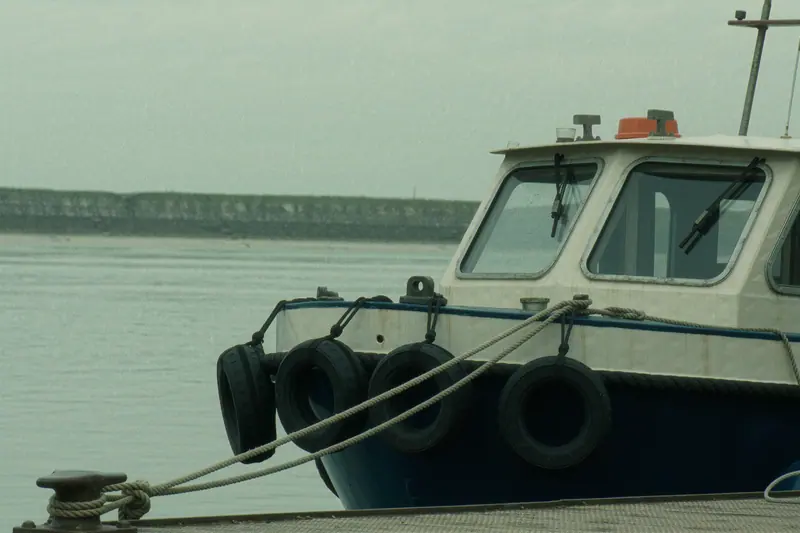
The clause that decides your winter date
Every serious contract on this river has a high-water provision, and it is not boilerplate. As the gauge rises, navigation is progressively restricted and above a stated level it stops. That is a decision taken for the whole waterway, not by your operator, and it can arrive with a few days of notice after heavy rain upstream.
Low water has a smaller but real effect: the fairway narrows, commercial traffic concentrates, and some jetties become awkward or unusable.
Both of these are more likely outside high summer. If your date is in late autumn, winter or early spring, ask specifically whether a cancellation by river conditions is refunded or rescheduled, and prefer the operator who reschedules — in that situation a date in the calendar is worth more than a refund. The Rhine current and what it means for small craft explains how the gauge and the flow relate to one another.
Booking against the hall calendar
This city does not have a summer season for boats. It has an exhibition calendar, and the private hire fleet is booked against it.
In the weeks of a large fair, hundreds of companies are looking for an evening that is not a restaurant, and a boat for forty people is the answer they all arrive at simultaneously. Those evenings go months ahead, and the price reflects the week. The pattern is identical to the one described in hiring a car in the exhibition weeks, for the same underlying reason: a finite local supply meeting a demand spike that was published years in advance.
The consequences are pleasantly simple:
- If your date is a fair week, book as soon as you know it.
- If your date is flexible, avoid the fair weeks entirely and book the same boat for a fraction of the effort.
- August is the quiet month here, on the water as on the road, and the middle of it is the easiest booking of the year.
- December is its own short peak around the markets, largely at weekends.
Getting a group to and from the water
The promenade jetties are walkable from the old town and the central districts, which is the main reason they are used. The harbour district is further out and usually means arranging transport at both ends.
Think about the return before the departure. A boat that lands thirty people on a riverbank at half past eleven has solved your evening and created a taxi problem, and on a fair week evening the ranks in this city are not deep. If the group is staying together, a return to the jetty nearest their hotels is worth more than a prettier route.
The best version of this, for what it is worth, is the shorter downstream trip on a weekday evening in early September: the light is long, the working river is busy, the fair season has not quite started, and the boat you want is still available.
What to check before you book
- Get the boarding jetty named and located, not just the district. Some are on the promenade, some are in the harbour area and some are downstream.
- Agree the route direction in advance. Upstream first and downstream home is the version that finishes on time.
- Read the high-water and low-water clause. Navigation here is restricted and then suspended above stated gauge levels, and that is not the operator being difficult.
- Confirm whether catering is brought aboard by you, by them, or by a third party, and who is liable for the licensing that goes with it.
- Ask what the boarding window is and what happens to latecomers. A jetty slot is usually fixed and the boat cannot wait.
- Check the return time against any noise restriction, and against how your group is getting home afterwards.
- Book against the exhibition calendar, not the weather. The evenings you want are the evenings four hundred other companies want.
Questions people actually ask
- How far ahead should I book a boat for a group?
Two to six months if your date falls in a trade fair week, and a few weeks otherwise. The fleet of vessels suitable for private hire on this stretch is small and finite, and during a large exhibition the corporate demand for a two-hour evening is far larger than the number of boats. August, by contrast, is frequently available at short notice.
- Which way should the trip go?
Upstream first, downstream on the way back, almost always. Going against the current at the start costs time when you have it and gains it at the end when you do not, and it means a delay does not push your return past the booked jetty slot. Downstream first feels faster and quietly sets up a late finish.
- What happens if the river is too high?
Navigation on this stretch is progressively restricted as the gauge rises and is suspended above a stated level, so a charter in a high-water week can be cancelled by the river rather than by the operator. Good contracts reschedule rather than refund, and that is usually the better outcome for you as well. Ask which it is before you pay a deposit, particularly for winter and early spring dates.
- Can we bring our own food and drink?
Sometimes. Practice varies, and where an operator has its own catering arrangement, outside supply is often restricted or charged for. Where it is allowed, remember that everything has to come down a steep gangway and back up it, and that on a floating jetty the angle of that gangway changes with the river level.
- Is a boat better than a room for a company evening?
It is better at one thing: nobody leaves early. That is also its drawback, because the boat returns when it returns. For a group that wants to talk, two hours on the water beats any room. For an evening where people need to come and go, or where half the group has a flight, it is the wrong choice.