On the roadDüsseldorf
Driving to the exhibition grounds, and the car park reality
All year
The halls sit in the north of the city between the airport and the Rhine, which makes them easy to reach and hard to leave. When the visitor car parks fill on an opening morning, what the barrier queue does at six in the evening, the delivery window exhibitors actually get, and the arrival plan that beats all of it.

The exhibition grounds occupy a large rectangle in the north of the city, with the airport a few minutes further north, the Rhine immediately west and the arena next door. On a normal Tuesday it is one of the easiest places in Düsseldorf to drive to.
On the opening morning of a big fair, it is the reason the whole northern half of the city stops moving. Everything below is about which of those two days you are having.
The approaches, and which one to take
Three roads matter. The motorway that runs across the north of the city has its own exhibition exit and is the default for anyone arriving from outside. The motorway that comes up from the south-east feeds the same junctions and is the one that backs up first, because it also carries the airport traffic. And the main road that runs north along the river through Golzheim is the local approach, slower but far less prone to a sudden standstill.
The practical rule: if you are coming from outside the region, stay on the motorway network and come in from the north. If you are coming from inside the city, use the river road and accept the traffic lights. Coming up through the middle of the city on a fair morning is the slowest of the three by a wide margin.
When the car parks fill
| Time on an opening day | Traffic on the approach | Car parks | What it feels like |
|---|---|---|---|
| Before 08:30 | Light | Empty, choose your spot | The version everyone should book |
| 08:30–09:30 | Building fast | Filling from the entrances outward | Twenty minutes of queue |
| 09:30–11:00 | Saturated | Near or at capacity | Directed to overflow, shuttle |
| 11:00–15:00 | Moderate | Turnover keeps spaces available | Fine |
| 15:00–17:00 | Light inbound, building outbound | Emptying | Fine |
| 17:00–19:00 | Gridlocked outbound | Exit barriers are the bottleneck | The worst hour of the week |
| After 19:00 | Clear | Empty | Fine |
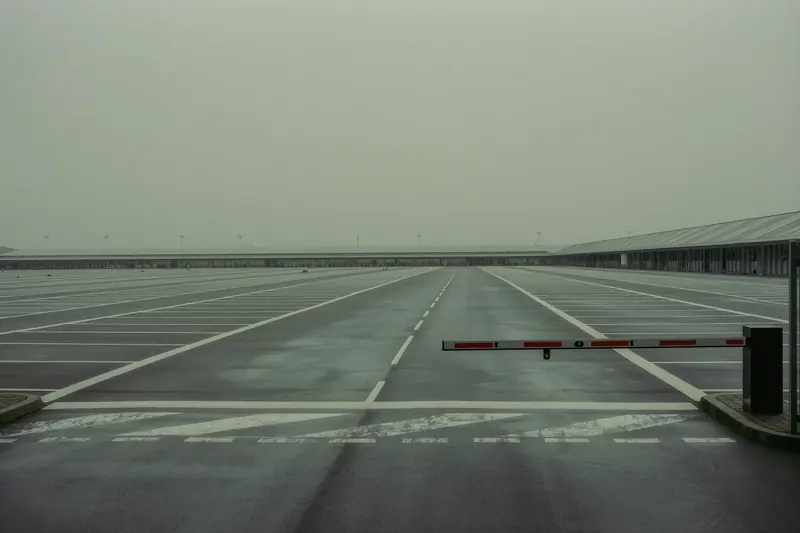
The exit is worse than the entrance, and it is worth understanding why. Arrival is spread across three hours and several entrances. Departure is compressed into about forty minutes at several thousand vehicles, all of them funnelling through barrier arms that process one car at a time. No amount of road capacity fixes a queue that is metered at the barrier.
If you are on a schedule, either leave forty minutes before the halls close or have a coffee and leave an hour after. The middle is a car park in the literal sense.
Exhibitors and the delivery window
Everything above concerns visitors. Delivery traffic runs on a different system entirely: slots, hall door numbers, waiting areas and a controlled release into the site.
Three things save an entire day here:
- Know your slot and your door before you leave the depot. A van that arrives without either goes to the waiting area and stays there.
- Hire the van for longer than the job. Build-up delays are normal, and a hire that ends at six in the evening becomes a problem at half past five.
- Do not plan to park the van nearby afterwards. Everything around the grounds during an event is either allocated, restricted or full. If you need to keep it, take it back into the city and read parking a rented van in Oberkassel and the inner districts first.
Build-up and break-down also explain why van hire across the whole city tightens for roughly ten days around a four-day event. The market effect is described in hiring a car in the exhibition weeks.
The case for not driving at all
For a visitor with a badge and a bag, the car is the wrong tool. The grounds are on the tram and suburban rail network, services are reinforced during events, and many event tickets include travel on the regional network — check yours, because if it does, the entire parking question evaporates.
There is also the geography. The airport is ten minutes from the halls with a direct rail connection into the city, so the common pattern of flying in, collecting a hire car and driving to a hotel in the centre only to drive back north the next morning is three journeys where one would do.
Where a car genuinely helps is the trip that is not the fair: suppliers on the edge of the Ruhr, a factory visit, an evening somewhere the trams do not go. In that case the sensible arrangement is to hire for those days only and take the tram to the halls, which is set out in airport car hire versus a city depot.
If you are driving anyway
Book the parking with the ticket. Pre-booked parking has its own approach and its own barrier, and on a busy morning it is the difference between ten minutes and fifty. Note the car park number and the section, because these are large, uniform areas of tarmac and every row looks the same at seven in the evening in November.
Fill the tank before you approach. The roads immediately around the grounds are not where you want to be looking for a station, and if you are returning a hire car to the airport the same evening on a full-to-full contract, the last thing you want is to join the exit queue twice.
And take the closing-day exit seriously. It is the only hour in this city where leaving an hour later genuinely gets you home earlier.
What to check before you book
- Check whether your event ticket includes travel on the regional network. Many do, and it changes the arithmetic completely.
- If you are driving, book the car park with the ticket rather than turning up. Pre-booked parking is a different queue.
- Plan arrival before nine or after eleven on an opening day. The hour in between is when everyone else arrives.
- For exhibitor deliveries, confirm your slot and the hall door number in advance, and know the waiting area you will be sent to.
- Fill the tank before you approach the grounds. The northern approach roads are not the place to look for a station on a fair morning.
- Leave before the closing bell or an hour after it. The exit barriers are the bottleneck, not the roads.
- If your hire is due back at the airport the same evening, add an hour beyond whatever you think is enough.
Questions people actually ask
- How long does it take to drive to the exhibition grounds?
From the airport, around ten minutes. From the middle of the city, fifteen to twenty on a clear road and up to forty-five in the peak of an opening morning. The grounds sit in the north, so anyone coming from the south or from the left bank crosses the whole city or the river to reach them, and that is where the time goes.
- Is there enough parking at the grounds?
On an ordinary event day, yes. On the opening day of a very large fair the visitor car parks fill during the morning and traffic is directed to overflow areas further out, with a shuttle. The parking exists; what runs short is the parking you can walk from, and the day rate in a big week is several times the ordinary city rate.
- Is it quicker to take public transport?
For most visitors, yes. The grounds are served by the tram and suburban rail network from the main station and from the airport, the service is reinforced during events, and it delivers you to an entrance rather than to a barrier queue. The exception is if you are carrying materials, in which case you were never going to take the tram.
- When do exhibitor deliveries happen?
In defined build-up and break-down windows either side of the public days, controlled by slot and by hall door, with a waiting area for vehicles that arrive early. Turning up outside your slot means sitting in that waiting area, sometimes for hours. Confirm the slot, the door number and the route in before you set off, and factor the wait into the van hire, not into your optimism.
- What is the worst hour of the week to be driving here?
The hour after a large fair closes on its final day, when the halls empty, the exhibitors start loading and everybody heads for the airport at the same time. The second worst is the opening morning between nine and eleven. Both are entirely predictable and both are avoidable by moving your plan by sixty minutes.